ATRA News

    This is a round up of the latest news related Personal Rapid Tramsport and Advanced Transport. If you would like to submit a news item please email news@atra.org

    Room To Move

    October 7th, 2015

    ATRA-OCT7

    Article by Will Ackel

    If you’ve ever visited a water park, you’ve probably seen a “Lazy River” ride like Castaway Creek at Disney World’s Typhoon Lagoon or Rambling Bayou at Adventure Island in Tampa, Florida. They are shallow channels of water with a strong current. You can sit in an inner tube and just ride the current, or you can swim with the current, and get a boost that makes you feel like an Olympic swimmer. Some parks are completely encircled by a Lazy River that serves as a kind of transit system. The river is the guideway, and the stations are steps or ramps that lead into the water. In a Lazy River, traffic jams can actually be fun!

    Automated Transit, in its simplest form, can also be configured as a single loop, with more complicated single-level networks comprising multiple intersecting loops. In the same way, a Lazy River could be expanded with additional loops. Of course the stretch of canal after a merge must have enough capacity to accommodate the combined water flow of the two canals that feed into it. Similarly, it must have enough flow to maintain the current in the two channels of the upcoming diverge. That means that the segment of canal between a merge and a diverge must have twice the cross-sectional area of the canals that feed into, or out of it. I refer to the part between a merger and a diverge as a double-density segment, and the parts leading into or out of it as single-density segments.

    It is well known among automated transit engineers that single-level Automated Transit Networks (ATNs) also have single- and double-density segments. If two guideways that lead into a merge are each fully loaded with pods running at the minimum headway, the following segment of guideway cannot accommodate the traffic without violating the minimum headway requirement. This is why it is considered good ATN design practice to alternate merges and diverges. If there were two successive merges before a diverge, then you would have a triple-density segment.

    This phenomenon is the source of the specious claim of automated transit critics that ATN systems cannot operate at more than half their capacity. They reason that in order for a transportation system to be economical, every part of it must be saturated with traffic at peak times. In the world of automobiles, this is known as gridlock. So by the flawed logic of the detractors, the only transportation system that is “practical” is one that is gridlocked.

    It is true that a single loop can be packed with vehicles along its entire length. And that’s fine if all the places you want to go are arranged along that loop. But as soon as you add the opportunity to turn left or right, you are faced with the need for extra capacity. That’s because sometimes all the vehicles will want to go left, and at other times they will all want to go right. This is true for any kind of vehicle that does not follow a fixed route, including automobiles.

    Think of one of those puzzles with the tiles that you are supposed to rearrange in numerical order by sliding them into the one open space. By the critic’s reasoning, that one empty space is wasted. But if you were to add one more tile, then nothing could move at all. How efficient is that? Mobility requires room to move. An adequate amount of unused capacity is not a design flaw – it’s a necessity.

    Moreover, the only reasonable measure of a transportation system is customer satisfaction, which by definition includes everything that matters to people. No one chooses a mode of transport because it has better capacity utilization. What people care about are things like comfort, safety, reliability, simplicity, cost, and travel time (including any walking, waiting, parking, transferring, etc.). By that standard, automated transit runs circles around anything else.

    Mr Ackel
    Mr Ackel

    A Very Brief History of Automation in Transportation

    October 6th, 2015

    ATRA-October

    Article by : Wayne D. Cottrell, Ph.D. California State University, Long Beach.


    Excitement, discussions, and progress continue with and around the rapidly developing technology of autonomous and self-driving cars. It is generally accepted that the notion of the automated car has been around since the 1920s, trials were conducted as early as the 1950s, and the first truly automated cars appeared during the 1980s. In the 30-odd years since the first automated cars were introduced, the idea has expanded greatly, to include experimental operation in mixed traffic, and the potential for mass production. In 2012, a Google driverless car successfully completed an urban trip chain, carrying a passenger who described himself as legally blind. Google’s cars had logged over one million miles on U.S. roads as of this writing. Technological improvements were still needed in inclement weather operation, obeyance of temporary traffic signals, complex intersections, object recognition, road surface imperfections, and safety officer signals. Experts within the Institute of Electrical and Electronics Engineers have forecasted that 75% of the world’s vehicles will be autonomous by 2040.

    Atra 1 News Oct


    A legally blind man prepares to take a spin in a Google self-driving car


    While great strides and giant leaps are being made with driverless cars, a brief review of automation in transportation may be informative and useful. Automated processing in transportation is now commonplace, of course. Trip planning, ticket purchasing, travel reservations, seat selection, baggage payment, and other transportation components can all be managed using automated systems. Automation in propulsion and guidance, and the driverless transport of cargo and people, was demonstrated nearly a century ago in some modes, but is relatively novel in others. Elevators, for example, were manually positioned at stops (i.e., floors in buildings) until well into the 20th century. Although elevators have not been “piloted” since the days of hand-powered mechanisms, human intervention for precise door operations was needed until electromechanical circuits with relay logic were developed to better control positioning. These circuits first appeared in elevator systems in the 1930s. Today, most elevators are on-call and operator-free. Elevator operators are still seen in some department stores, subway stations, and amusement settings in Japan, the U.S., and elsewhere, however.

    Automation in railroads – driverless trains – was first implemented in London in 1967, on the London Underground’s Victoria Line. The level of automation of the line is “Grade 2,” with automated operation between stations, but with an in-train driver who is responsible for controlling the doors at stops, detecting obstacles along the tracks, and emergency situations. Grade 4 automation, in which on-board personnel are for customer service only, was first implemented in an airport setting during the late 1960s (Tampa, Florida), in a university campus setting during the 1970s (Morgantown, West Virginia), in an urban downtown during the 1980s (Miami and Jacksonville, Florida; later Detroit, Michigan), and in a metro-subway system during the 1990s (Paris, France). Regarding the latter, European and Asian systems have taken the lead in using Grade 4 driverless trains in high-capacity operations. In the U.S., no Grade 4 high-capacity trains are in operation, although San Francisco’s BART system has had built-in Grade 4 capability since the 1970s. Further, some airport automated people-movers, such as Hartsfield International Airport’s (Atlanta) “Plane Train”, which carries over 60 million riders annually, are nearly high-capacity systems.

    Atra 2


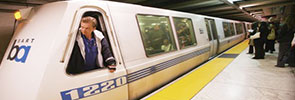
    San Francisco’s BART trains have Grade 4 automation capability, but nonetheless have drivers


    Predating elevators and trains, aviation may have been the first mode of transportation to implement automation widely. In 1929, James Doolittle, with his cockpit covered with a canvas to blind his vision, took off, flew and landed using instruments only. It was a 15-minute flight in the New York area, and into history. Further developments led to ground-based instrumentation, with the first fully automated landing of an aircraft occurring in 1964. Today, aviation regulations pertain to two types of operation: IFR (instrument flight rules) and VFR (visual flight rules). The VFR apply when an aircraft can be operated by visual cues only, such as during the daytime, under cloudless skies. The IFR apply otherwise, and for commercial aircraft, apply at all times, even if the plane can be operated safely under VFR.

    Atra3


    James Doolittle, under the canvas, and his copilot, get ready for the first “blind” flight (1929)


    In this brief examination of automation in elevators, railroads, and aviation, there are plenty of lessons in development, policy and progress which may help guide the automation of other modes, such as motor vehicles.

    Technix 2016: Envision Automated Transit (EAT)

    September 24th, 2015

    Hosts: Advanced Transit Association (ATRA), University of Maryland Center for Advanced Transportation Technology (CATT), & Southern Illinois University (SIU)


    Date: Saturday January 9th, 2016

    Time: 10:00 am – 4:00 pm (Doors open 9:00 am)

    Location: Atrium of the Kim Engineering Building at the University of Maryland 8228 Paint Branch Dr., College Park, MD 20742.

    Open to the public


    Come join the Advanced Transit Association (ATRA) as we host Technix 2016.Technix’s theme for 2016 will be Envision Automated Transit (EAT). EAT will be a continuation of the Envisioning Automated Vehicles within the Built Environment 2020 2035 2050 workshops held at the past two Automated Vehicle Symposiums hosted by TRB and AUVSI. These workshops brought together planners, engineers, architects, technologists and researchers to redesign the built environment with automated vehicles. Participants were introduced to automated vehicles and given pathways on the development of automated vehicles. Participants in groups led by scenario discussion leaders were assigned scenarios and sites to design around. EAT will be very similar to that past two workshops, but with an emphasis on automated transit– how is transit being redefined?


    The Annual ATRA business meeting will follow EAT for ATRA members only.

    Registration Fees (includes breakfast and lunch)

    General Registration $50

    ATRA members (includes dinner to be served at the ATRA Business Meeting) $50

    ATRA members and public sector employees (DOTs, local government, transit agencies) $35

    Prices rise by $10 after December 21.


    Registration Type


    If you are interested in sponsoring Technix 2016, please email Reuben Juster at RMJcar@gmail.com with your contact information. Your generosity will be appreciatively acknowledged on all workshop documents and communications.
    We have 3 sponsorship levels.
    $800 Platinum (1 Available)
    $400 Gold (2 Available)
    $200 Silver (4 Available)

    Once approved, please pay using the PayPal button below.


    Sponsorship Levels


    Getting ATN Systems Developed and Built In America

    September 9th, 2015

    GronningArticle_Oct15ATRA

    by Dick Gronning.

    In order to figure out why new transportation systems haven’t come into use since the 1970s, when PRT first came on the scene, I developed a list of what I have heard and seen, both in Minnesota and nationally. If we start off with specific reasons for not building the systems, then perhaps we can find solutions and put ATNs into operation here in America.

    • It hasn’t been done before. Transportation for urban areas has only developed incrementally. Catherine Burke made the point that disruptive technology has been virtually eliminated.
    • The experts don’t buy it. Consultants and transportation experts have been educated to the point of indoctrination in the present modes. With a few notable exceptions, they can’t seem to project their thinking beyond present systems and can’t envision the operation and management of truly disruptive systems.
    • Politicians have set their careers on some other existing system. Newer, better systems might interfere with the system that the elected official wants to be built. I have heard about the conflicts raised with this situation.
    • Well meaning people are unable to conceive of the use of these proposed systems.
    • There is no immediate ROI (Within 6 months). I was told this by a local investor. He told me that he invests $3-5 Million at a time for each investment. He averages a third back on each investment. Whether he profits or not, he is out of the deal in six months.
    • It is an unsafe investment because it hasn’t been done before. I was told that there are investment categories. If there isn’t a category for investing, then it is hard to get private investment.
    • A corporation (multinational mega-corporation) won’t make $$$.
    • There is no existing metro-wide system to look at and/or study. It seems that figures from existing systems have to be obtained before a next system can be either publicly or privately purchased and built.
    • People can’t envision it – there is no vision! It certainly isn’t true of the general public. When they see it, they get it. Of course, this attitude leaves America at best as #2 in the world.

    What can be done to counteract these items?

    We have tried presenting new systems to the public with a great deal of success. The public seems to have no problem understanding what new systems can do. The voices of the people don’t seem to be heard by decision makers. Who makes the decisions on transportation and why can’t we get new systems built?

    From what I have heard and seen, the final decision rests in the hands of elected officials. They appoint the committees that administer transportation and such committees must follow the wishes of the elected officials. But the elected officials aren’t educated in engineering as a rule. So, they listen to lobbyists, hire consultants, and follow party lines. There is a circle that goes around, because consultants can only give out figures on existing systems. Therefore, nothing new in transportation can be built, at least within the public circle.

    Even if a system could be privately financed, there seems to be opposition, at least to a public location. But how do we even get private finances? What is needed is qualified experts that are in a position to educate and influence people who make decisions.

    We need trustworthy developers. What I mean by that is that the developers must be able to show the investors that they have a track record, that they have the insurance, and that they have the finances to complete the job of development and rectify any possible mistakes. But how can a developer show all of these qualifications?

    Developers need to align themselves with providers that have a track record. In the past large, multinational corporations have indeed been interested. Raytheon is an example. But the engineers at Raytheon didn’t produce a system that could be sold. Their system seemed to be overdeveloped and therefore too expensive. So, if some large corporation were to be part of this development, the question remains, how does the main developer steer the corporation towards an acceptable system that can be sold? How could any developer keep a large corporation from simply shelving any development? I don’t have an answer to these questions.

    Another possibility is to form an alliance with a number of mid-sized corporations who are experts in a particular field and have a track record. Such corporations have the reserves to correct any errors and have insurance. But what kind of an alliance? Should such corporations be passive providers? How would they work together in order to produce the final system? The concept of a developer working with subcontractors hasn’t provided us with any systems yet. I think that some sort of new business model might be in order, a model of partners that are active participants in the development of the final system. Each part of such an arrangement would have to interact with the rest for a satisfactory result.

    With the reserves of each partner in such a partnership, investors might be attracted to the project. Each member would have a track record of development in their respected field and a history of satisfactory projects. Working together as a team, this well might overcome the reservations of investors. Each member already has a background of successful business deals, finances, and insurance. They already are worth something. There would be a substance that investors could lay their hands on.

    Of course, this is speculation. Until a system is up and running, we won’t know what it will take, what will attract investors. There are many types of investors, such as legacy investors that want to leave their name on a project, realtors that can see a profit in investing in transportation, charitable branches of for-profit corporations, and probably more.

    For this group, can we add to this picture of types of organizations, approaches to investors, and visions of how to get systems built?

    This picture is of Don Mathews, an engineer at that time for Taxi 2000 and Richard Gronning
    riding the Taxi 2000 vehicle at the T2C headquarters.GronningArticle_Oct15


    The California Infrastructure Institute (CALII)

    August 27th, 2015

    ATRA-295x100The California Infrastructure Institute (CALII) is a non-profit corporation formed in the public interest to be a catalyst for collaboration between governments, businesses and academia. Our purpose is to begin a process that will lead to automated transportation networks (ATNs) that are tested, proven and sufficiently standardized such that local authorities can purchase a system with an acceptable level of risk using normal procurement processes.

    Despite small-scale ATN operations in Heathrow, Masdar City and Suncheon Bay, other cities that have expressed interest in such systems find themselves ‘stuck’ due to the inherent risk and uncertainty regarding what is perceived to be an unproven technology. Cities and other local authorities are understandably hesitant to adopt innovation that may or may not be both operable and acceptable to the public.   While there are enthusiasts who are ready to move forward, often having decided upon a specific vendor’s system, the politicians and planners are both more skeptical and more deliberate.

    Which system is best, or least likely to become a ‘technological orphan’? Which company has the financial resources such that the buyer can be assured that they will be around when new parts are needed, technological advances must be incorporated, or simply to deal with problems as they arise? Have any of the vendors really proven their system can operate as a complex network as advertised? Will an elevated track be acceptable to the public? The skeptics see technical, economic, social, environmental, regulatory and political risks — the sum of which means it is easier to say “no” than to actually move forward.

    The Aerospace Corporation, a Federally Funded Research and Development Center (FFRDC), is a technically competent and technology neutral organization that studied ATNs for the City of San Jose. They recognized that the existing small systems have demonstrated their viability, and could serve Mineta Airport. The vendors had not, however, shown that their claims of being fully scalable and able to expand to serve a larger city had been demonstrated.

    There is a need for demonstration, not on the streets of a city but on a Proving Ground for independent third party assessment and certification of ATN systems. Such a proving ground is where technical glitches can be worked out, standards for fit, form and function established, human factors tested, movement through stations of various sizes modeled, physical and cyber-security advanced, and where public acceptance can be demonstrated.

    ATRA-CALIFORNIA-1

    A proving ground is where computer models can be extended and pushed to their limits, subsystems can be tested and, where necessary, modifications can be made before use in the public domain. Such a facility would provide training for designers, network planners, operators and maintenance staffs. It would also provide a place for regulators to learn how to regulate such new systems and certify their safety for public use. (An ATN is not a train.) Operations on a proving ground would provide data to extend economic and environmental models, again reducing risk and uncertainty for local authorities and transit operators.

    We believe a proving ground, similar to the ones the FRA has for railroads in Colorado and MIRA operates in England for automobiles, would help vendors prove the worth of their proposals – and such independent testing would just as surely expose their weaknesses. The proving ground would make it easier for vendors to bridge both the technological and commercial ‘valleys of death’ where they now appear to be stuck. With the development of technical and quality standards, multiple vendors will be able to compete, thus reducing single-source risk.

    Local authorities that participate in this process will be able to set objectives for systems in their jurisdictions and can learn how ATNs might solve the actual transportation problems they face. By linking vendors and potential buyers in a collaborative relationship, technologies will not be developed in a vacuum but can be directly related to promising pilot projects in urban areas. The local agencies will learn how to effectively procure complex technical systems, thus reducing risk before large decisions and expenditures must be made.

    ARTA-2-CALIF

    CALII is a group of interested private citizens with diverse and relevant professional qualifications. As a non-profit formed in the public interest, we are non-partisan, entirely independent, pro-bono and technology agnostic. We expect to be a reliable repository of objective information and an enduring voice of reason in order to educate the public and public officials regarding new infrastructure technologies.

    We intend to promote, engage in and sponsor research in both the pure and applied sciences for the advancement and betterment of urban transportation and related civil infrastructure to serve a public benefit.

    We provide a medium through which public and private entities – cities, counties, metropolitan agencies, ports and airports, businesses and all other persons interested in the development and deployment of advanced transportation and associated civil infrastructure can sponsor research and development for the public benefit.

    Author:   Catherine G. Burke

    Letter to the Editor of San Jose Mercury News – August 14, 2015

    August 26th, 2015

    ATRA-AUG-2015letter to the Editor of:  San Jose Mercury News

    August 14, 2015

    It’s troubling when elected officials who make transportation decisions misrepresent advanced transit options like Personal Rapid Transit (PRT). Such was the case at Thursday’s Transportation Town Hall sponsored by the SJ Chamber of Commerce. Our State Senator dismissed the option of using above-ground PRT technology rather than underground BART by saying PRT did not have enough capacity. Although he believes that PRT cabs (or “podcars”), each carrying only 1 or 2 people, cannot deliver as many people per day as BART trains, he clearly did not run the numbers.

    VTA projects daily ridership for the extension of BART from Berryessa to Santa Clara at 55,000, or about 28,000 each direction. If each computer-controlled podcar only contained 1 passenger, and headways (spacing between podcars) were the 2 seconds recommended for human-controlled cars, each PRT guideway could deliver 1800 people per hour (p/h) – or 86,400 passenger per day (1800 p/h x 24 hr). At a cost of $180M, PRT could provide 24/7 service, start operating years sooner, and save the taxpayer $4700M and the need for another screw-the-poor sales tax.


    By Rob Means, Electric Bikes

    The Missing Links for a Sustainable Future

    July 14th, 2015

    elevated_automated_guideway

    by Chair Rod Diridon, Sr., US High Speed Rail Association, Emeritus Executive Director, Mineta Transportation Institute,Chair Emeritus, APTA High Speed Intercity Rail Committee.


    Ridership is up dramatically on all modes of public transportation especially rail transport. The wonderfully aware and responsible millennial generation have decided to try to save the world for humanity by being sustainable.  They, the Pope, and the vast majority of our population know that climate change is out of control and 40+% of that terrible threat comes from carbon-powered transportation. In addition, in the Sunbelt areas with expanding populations moving more employees and products, traffic is becoming seriously problematic with congestion reaching near terminal gridlock levels.

    The states, with some help from the federal government, are working hard to find remedy’s and are expanding all modes of transit. Light, metro, commuter, and intercity rail ridership is up dramatically. Finally, high speed rail is now under construction in California and serious planning is moving ahead in the north east corridor, Florida, Texas, and from Chicago to St Lewis. But the missing link in those systems is the first and last mile that delivers the commuter from home to rail transit and from the job-end delivery station to the employment location.  Those two aspects seem generally overlooked as the rail systems are planned.

    First, at the commuter-shed end there must be Transit Villages built atop and around the rail stations and parking at high densities.  This is done throughout the world but less so in the US.  The construction of a cement podium a level above the station, tracks, and parking creates a new area for living, a new tax base for the community, and avoids unserviceable urban sprawl. Overlooking the expanse of grass atop the podium would be the high rise towers juxtaposed at angels to preserver sight lines.  The future commute, as with other countries, will be by elevator to the rail station then by rail to work.

    But the other important missing link is the employment-end, last mile which is where Automated Guideway Transit comes in. AGT can connect the rail station in a general industrial and commercial area via continuously moving automated pods or vehicles that provide cross-platform transfer access from the arriving rail system directly to the employment location stop by coding that stop into the vehicle.  These lighter, elevated system are less expensive to build and operate and can use current boulevard medians diverging into major employers reception areas to allow direct access for employees or visitors without having to brave the terribly congested and unpredictable roadways.

    The technology for AGT and for Transit Villages is tried and proven in other countries many of which are now in compliance with the old Kyoto Accords for air quality. All we require to accomplish that seamless system for the US is the political courage to zone the increased density at the commuter-end stations and negotiate with the public for either the tax support or public-private partnerships to build the AGT connectors at the employment end.  If we intend to leave a livable world to our children, we best find that political courage very soon.

    XXXXX

    Hope that works.  Good luck!

    Rod

    TRB 95th Annual Meeting: Call for Papers

    June 9th, 2015

    trbKey Considerations for Automated/Driverless Vehicles on the Airport Terminal and Ground Transportation Network

    The Standing Committee on Airports Terminals and Ground Access (AV050), is seeking papers exploring how automated/ driverless vehicles might affect airport terminals and airports’ ground transportation network. Automated vehicles could change:

    • Airport parking space requirements and more importantly airport parking revenue
    • Curbside zones
    • Internal circulation systems
    • Luggage handling
    • Roadway networks
    • And many other aspects

    Details here: annualmeeting.mytrb.org/CallForPapers/Details/107

    Passenger Transport has been changed by ATN Systems

    June 8th, 2015

    Robbert_2getthereSince 1999 Robbert Lohmann, together with 2Getthere, has completely changed the market for automatic passenger transport. In the past, large vehicles followed a fixed, linear route at a low frequency. The technology of 2Getthere made it possible to create a fine meshed network using reference points in the road surface and with smaller vehicles at a higher frequency. The company created the first PRT (personal rapid transport) system in the world in Abu Dhabi.

    According to Lohmann he has the best job there is: “You do need patience, but these are amazing projects that tackle transport problems and work on solutions for the coming future. Besides, the international contacts you make are very valuable.”
The company is indeed very internationally orientated. A few of the projects from 2getthere are located, for example, in Taiwan, Singapore, Dubai, Qatar, the US, Belgium and England. It usually involves prestigious projects. 
At this time The Netherlands are still more conservative, while abroad one dares to dream bigger. And all of this is happening at the head office in Utrecht.

    Little knowledge in The Netherlands
    In The Netherlands, little is known about the solution offered by Lohmann and his company. 
”We’re like the least known company in the most famous industry. During the last two years more attention came to the work of 2getthere since autonomous cars entered the spotlight. Those cars are still at the beginning of their development, while our systems are already in use for several years.”

    “We need research into battery management systems.”

    A new generation vehicle
    Recently a lot of attention has been paid to research. Some major projects are running right now as we speak. In future the economic impact will increase and there will be even more contracts with secondary parties. At this time a new generation vehicle for Group Transport is being developed. “We can’t do this all by ourselves. There must be research on eg battery management systems. A new design must be developed in close collaboration with our suppliers. We always take long-term partnerships in concern, because you build the expertise together and then you can switch faster and are better attuned. ”

    New employees are welcome
    To meet the demand at present times, it is estimated that the company will grow from 25 to 35 or maybe even 40 employees in the Netherlands. The challenge is to find not only good people, but also the right people. “We are ‘picky’, we all put heart and soul in our work and that’s what we expect from everyone in the company. The involvement of employees is essential. A small example: sometimes the greatest activity on the servers is at 2am”. ‘Lohmann: ”Right now, the work is in developing the new vehicle and there are three projects to be completed in 2017: a whole challenge!”

    The winner of the first annual Martin Lowson paper award

    June 8th, 2015

    monica_zarafu_lowson_awardThe winner of the first annual Martin Lowson paper award is: Monica Zarafu, University of Technology Sydney (UTS), Australia.

    Due to the generous support from the Lowson family, an annual student paper award has been established. The late Martin Lowson was the visionary behind the ATN system at Heathrow airport. He loved working with students and fostering their creative and innovative ideas. Due to his dedication, hard work and entrepreneurially qualities the modern ATN vision was realized. ATRA thanks his family and honors his legacy with this award.

    ATRA fosters the development of automation and networking to advance the quality and sustainability of transportation, particularly for our urban areas. The objective is to recognize high quality, original work that advances the thought and practice of fully automated networked public mobility systems. The emphasis in the inaugural 2015 award was on Automated Transit Networks toward sustainable urban mobility. Congratulations Monica Zarafu!!

    Monica Zarafu is a transport engineer specialized in transport technologies with a Master by research in Built Environment from University of Technology Sydney. Areas of expertise include travel demand estimation and forecasting infrastructure needs, multi-modal transport systems, and integrated transport and land-use evaluations, with academic, local government and industry practice. Her research interest is in identifying and evaluating innovative transport solutions for twenty-first century urban forms, with a focus on finding a sustainable equilibrium between individual and collective interests. Under a collaborative research program funded by the Australia’s national science agency CSIRO, Monica investigated how effective a Personal Rapid Transit system could be in retrofitting edge cities using a local business park, Macquarie Park as a case study.

    This paper is available on our Papers page: www.advancedtransit.org/library/papers