
History of the Advanced Transit Association (ATRA) Year by Year
CHAPTER THREE
by J. Edward Anderson, first ATRA President.
1978 – The Third Year.
Significant Events
UMTA
Assessment of Operational Automated Guideway Systems – Jetrail, by George Anagnostopoulos et. al. 280 pp.
Development/Deployment Investigation of Cabintaxi/Cabinlift Systems, by V. J. Hobbs, W. Heckelmann, N. G. Patt, J. H. Hill, 432 pp.
Over 200 people attended the ACT Conference sponsored by the USDOT’s Transportation Systems Center in Cambridge, Mass. The big news was that George Pastor announced that UMTA has selected two AGRT systems instead of one to proceed to phase IIB of the project. The two are Boeing and Otis. They continued the work till the mid 1980s.
Miami will proceed with its mass transit project that will combine a 3.3-mile downtown people mover with a 16.5-mile elevated rapid transit system.
The Tri-State Regional Planning Commission is applying for federal grant money for an “accelerated walkway system” for Hoboken, NJ.
UMTA is “wait and see” on the Cleveland DPM.
All ten DPM finalist cities will receive preliminary engineering money.
St. Paul DPM Threatened. Consultant’s figures show the cost of building a St. Paul downtown people mover far exceeds the original estimate.
Boeing is building 28 new vehicles for the Morgantown AGT system.
Seattle
The City is asking for UMTA money to upgrade its existing Monorail as a state-of-the-art DPM by adding 2.7 miles of guideway and five stations.
Boeing
Boeing Aerospace Company acquired world-wide rights to the ROMAG transit system technology developed by Rohr Industries of Chula Vista, CA. The ROMAG concept is suitable for either low-speed, short-haul urban transit or high-speed intercity transportation. The ROMAG vehicles are magnetically levitated and propelled by linear induction motors.
Berlin, Germany
The government of Berlin commissioned an AGT feasibility study. Three systems: Cabintaxi, C-Bahn, and H-Bahn are considered.
At ATRA
New Specialty Area Subcommittees formed for New Systems Implementation and Deployment:
- Availability, Reliability and Maintainability
- Safety
- Communication/Command and Control
- Supervisory Systems
- Implementation Process
- Operational Process
- Transit Vehicles
- Civil Structures
- Electrification and Electric Distribution

Dr Kieffer
Dr. Jarold A. Kieffer led a Board of Directors discussion about how to sharpen debate, based on an article he wrote “To Improve the Quality of Transit-System Analysis, Planning, Design, Information, and Implementation.”
New Publications
The High-Speed Ground Transportation Journal formally becomes the Journal of Advanced Transportation. Spring, Summer and Fall issues are published.
Transit Systems Theory, J. Edward Anderson, a 340-page book with a Forward by UMTA Associate Administrator George Pastor is published by Lexington Books.
City Traffic: A Systems Digest, Horst Weigelt, Rainer Gotz and Helmut H. Weiss. This book surveys the inadequacy of existing urban transit systems, provides an overview of proposed alternatives, modifications and innovations, and explores new developments in the U. S., Europe and Japan.
Fundamentals of Personal Rapid Transit, by Jack H. Irving with Harry Bernstein, C. L. Olson and Jon Buyan, a 352-page book was published by Lexington Books. This is the result of years of work at The Aerospace Corporation and provides the best ways to advance the Systems Engineering of transit.
First ATRA Conference
“A virtual “Who’s Who” in metropolitan planning and urban transportation tops the agenda for an ATRA international conferenced scheduled in Indianapolis April 25-28, 1978. The conference will explore the theme “Advanced Transit and Urban Revitalization – An International Dialogue.” More than 500 delegates are expected. Special speakers included Detroit Mayor Coleman A. Young, UMTA Administrator Richard S. Page, American Institute of Architects Executive Vice President David O. Meeker, General Motors Executive Vice President Howard H. Kehrl, English architect and constant Brian Richards, Director of General Planning for Copenhagen Kai Lemberg and Hamberg Transportation Company Board Member Hans Hermann Meyer. U. S. DOT Research and Development Resources Manager Robert L. Paullin is the Conference Program Chairman.
The availability of the Conference Proceedings for $40 was announced.
ATRA Articles of Incorporation were revised to read: “The Advanced Transit Association is organized exclusively for education in the analysis, design, planning and implementation of advanced transit systems.”
For a fee of $300, a Transit Course called “Transit Systems Theory” is offered at the University of Minnesota and taught by J. E. Anderson.
Articles
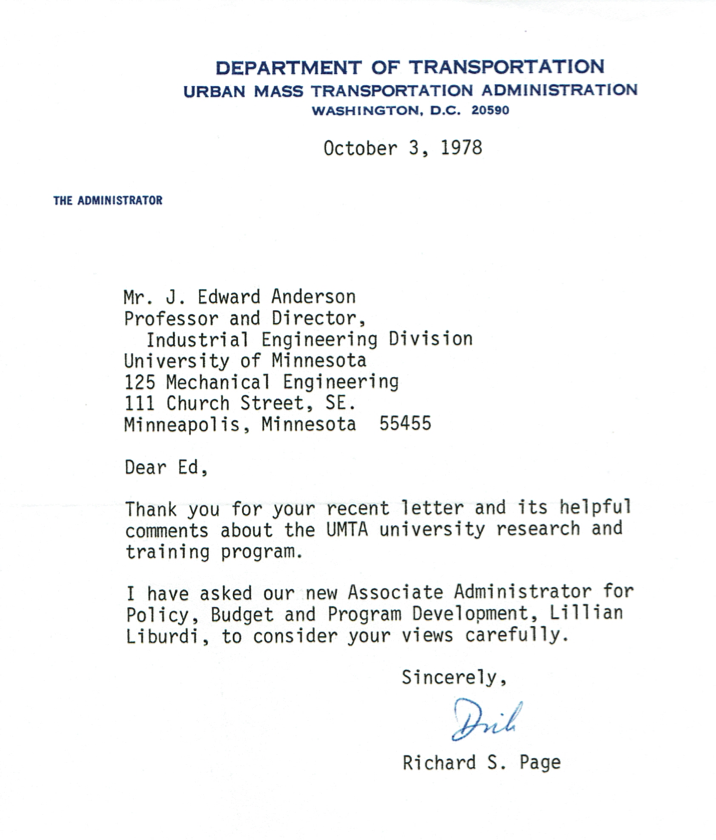
Based on attending the ATRA Conference, journalist Neal R. Peirce wrote a two-page article entitled “The Promise (and Pitfalls) of Transit Technology.” He concluded that: 1) advanced technology can provide significant labor savings, 2) well-designed systems could reduce congestion, 3) the USA cannot afford to leave the area to other countries, and 4) if severe shortages in oil develop, the USA will regret not developing every potential. Yet, why so many difficulties? UMTA said that it is necessary to deploy existing systems more gradually. Others argued that it was necessary to do comprehensive systems engineering first and resist efforts to move too fast too soon.
A letter to the Publisher and Editor of the magazine Mass Transit by J. E. Anderson was published in Vol. 2, No. 4 of Advanced Transit News. Here is one sentence from the letter: “Putting any automated system in a downtown simply won’t do. It must be a visually attractive system, economical in energy use in all kinds of weather, capable of excellent service, moderate in cost, and cleanly and reliably designed. To do these things, it must be designed based on fundamental understanding of all aspects of the theory of transit systems, and it must be adequately tested before deployment in a city.”
“A Princeton University Study Compares AGT with Conventional Transit.” The study considered alternatives for the City of Trenton and concluded that, while AGT has a great many advantages over the other transit alternatives, particularly with regard to the level of service, AGT was not sufficiently developed, and hence the authors recommended a bus system until real AGT could be ready.


