Archive for July, 2017

PRT needs to distinguish by performance from self-driving cars – or submerge in them

July 28th, 2017

station2


Will PRT be able to distinguish itself from self-driving cars? Self-driving cars are believed to be able to run on any paved road, on exclusive lanes or on lanes with mixed traffic, with or without a driver, shared or private. This flexibility could open a mass market because there is a smooth transition from the conventional, privately owned car to the automated and shared car of the future.

I believe it is unlikely that shared, fully automated taxis will perform a significant share of urban trips in any foreseeable future. But already the hype, hope and imaginations generated by self-driving cars risk to overshadow, dilute and absorb the concepts and potentials of PRT. Surely, PRT systems, which are already in operation since years, will also profit from the self-driving car propaganda and face better informed clients, less technological skepticism and less regulatory obstacles as compared with the past years.


But what is the main distinguishing feature of PRT? “It is the dedicated guideway” – in the expert’s opinion. However, would this argument be convincing to many clients or potential users, would it make headlines, would it attract investments and open large markets? Probably not. One may even comment that guideways are additional costs and self-driving cars could make use of exclusive guideways too, if necessary.


In my opinion, only if PRT achieved an outstanding performance by making an appropriate use of dedicated guideways then its breakthrough would still be possible: Compared with self-driving cars, PRT would be safer, achieve much high capacities, run faster, be more reliable and energy efficient, vehicles would be lighter and cheaper, and infrastructure would also be lighter and slimmer. Such a PRT system would let self-driving cars look like outdated, heavy and slow technology.


But what is the appropriate use of dedicated guideways? The most important properties of dedicated guideways are that they guarantee a predefined operating environment, the motion of all vehicles is predictable and there exists a small air-gap between vehicle and guideway. These properties can and should be technically exploited; here are some examples:

  • Gripping or squeezing of guide-rails with wheels or brakes: this guarantees decelerations and accelerations, maintains predefined headways and therefore provides high safety levels and reliable operation in most weather conditions.
  • Stabilizing guide-rails: if guide-rails are used to force the vehicle to say on track then speeds can be reliably increased, in particular in curves.
  • Short distance communication devices and sensors: wireless communications and sensing over a few milliliters (between vehicle and guideway) are fast, delay-free and interference-fee; this allows a rapid and precise location of vehicles; further, vehicles can “see” each other through the guideway. This feature contributes to a safely decrease in headways and an increase in capacity.
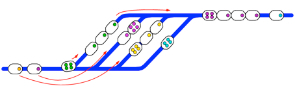
  • Automated, mechanical coupling: this is a proven and reliable way to couple vehicles together and to form dynamic trains of arbitrary length; such trains would further boost PRT capacity; vehicles with identical destinations or directions could be joined in special stations, as shown in the figure.
  • Synchronous PRT motorways: on high capacity network links, all vehicles would run at high speeds with synchronous motors (with either rotatory motors and a common 3-phase power supply or with linear synchronous motors). Because all vehicles are tied to a common phase, there cannot be a relative movement between vehicles on this link. This means that safety is guaranteed, even at very short distances. Note that with this concept, vehicles need to pre-accelerate to enter the main stream in an asynchronous way, similar to the maneuvers on motorway ramps.
  • Power transmission: the small and precise distance between vehicle and guideway allows efficient power transmission, either through current collectors or inductively; there is no need for large, heavy and costly batteries.
  • Vehicle prediction: in absence of interferences from other traffic participants, the position and future position of all vehicle are predictable with a high precision. This fact allows ultimately to optimize the on-demand services (minimize waiting times) and to reduce or entirely avoid traffic congestion.

Figure: Station where PRT vehicles with a common destination are coupled together to form trains


This list is not exhaustive. Some features are already realized in existing PRT systems, some are new and need a reality check. However, all of these features cannot be easily implemented with free ranging vehicles, such as self-driving cars. It is my conviction that by consequently developing and optimizing most, if not all, of these guideway-related technologies, one would end up with a PRT system that outperforms self-driving cars, as well as medium capacity light rail trains.


None of the features in the above list is science fiction; I claim that it is more difficult to develop cars able to run through traffic-congested cities without a driver than to implement the features in this list.


The suggested developments do need considerable funding. This is why it is important to deliver accurate impact estimations and demonstrate how such a PRT-network would perform against a fleet of self-driving cars in the same urban settings and with the same transport demand. For this purpose, we are working on large scale micro-simulations and build scenarios where door-to-door trips are simulated with different transport scenarios, including walking, conventional public transit, cars, bikes, and PRT.


By: Joerg Schweizer



International Podcar City Conference comes to Las Vegas, USA

July 27th, 2017

podcar

International Podcar City Conference comes to Las Vegas, USA

November 8-10 2017 in Las Vegas, USA 

Eleventh annual event focuses on automated mobility for

Smart City, Smart Transit, Smart Energy

Press release – for immediate release

San Jose, CA and Las Vegas, NV – July 27th 2017


The Eleventh Annual International Podcar City Conference is set for Wednesday – Friday,

November 8-10, at the City Hall of Las Vegas, NV. Podcar City will address the importance of

automated mobility and on-demand operations pertaining to energy, cityscape, and livability.

150-250 participants are expected, including city planners, transit planners, consultants,

architects, engineers, investors, developers, elected officials, and academics. Podcar City is

organized by the International Institute of Sustainable Transportation (INIST) of California and

the Advanced Transit Association with support from the Mineta Transportation Institute, San

Jose, CA,

In parallel and culminating at Podcar City, the Urban International Design Contest (UIDC) has

been organized to inspire municipalities and universities to think broadly about their transportation

network. The UIDC takes place from July 1 until October 16 and connects students and city

professionals with the goal to educate, inspire and motivate important stakeholders in how new

modes of sustainable public transportation can be utilized in an urban environment. Independent

judges will score each team on their presentation which must include Automated Transit Network

technology (ATN) defined as self-driving vehicles at grade and/or a separate guideway which

provides transportation for the general public, a real future city/urban project in need of transportation,

and a 4D simulation model. Currently the cities of Sundbyberg, Jacksonville, Las

Vegas, Gävle, Washington D.C and Perth are participating.

Information about the conference and the design competition is available at

www.podcarcity.org/lasvegas and www.facebook.com/UIDC2017

“Podcars are similar to the driverless trains we see at airports and other facilities around the

world,” said Christer Lindstrom of INIST. “But these are built as smaller cars for about six to

eight passengers. Initial systems are expected to fill the need for short trips or for connections

between transit modes. We expect the technology to eventually evolve into larger systems such as

the recently decided 1500 vehicle/100 kilometer system in Ajman, UAE. Elevated tracks will

allow them to operate without impacting street traffic and autonomous public vehicles using

existing roads are already deployed at various locations all over the world. Since the last

conference there has been a tremendous increase in interest and investment in these

technologies.”

The conference will open on Wednesday with a series of workshops and display of various

vehicles and concepts.

International speakers representing government, business, and professional organizations will

come from across the U.S., France, Australia, Sweden, Italy, the UK, Mexico, China and the

Netherlands.

Sessions include:

– Industry practice from around the world on autonomous transit systems

– Mobility planning from several cities utilizing live virtual 4D models

– Mobility as a Service (MaaS) & Automated Transit Networks (ATN)

– Global trends and project developments

– Smart city discussions including digital payment, and multimodal connectivity

– New mobility and its relationship to sustainability, energy and climate

– Safety and Security

– Integration of sensoring and the Internet of Things (IoT)

Matthew Lesh, formerly of the U.S Department of Transportation, is pleased to assist with the

organization of Podcar City. “The initiative fits perfectly within our knowledge and experience

on mobility services. Over the past several years we have seen a real convergence of Intelligent

Transportation Systems (ITS), mobile technology, and automation. Ensuring that we use these

technologies in a sustainable and meaningful way will have positive impacts not only on our

transportation networks, but on society, providing more access, greater accessibility, and added

efficiencies.

The Mineta Transportation Institute in San Jose, California has been a long-term supporter of

new, sustainable technologies that help address first and last mile challenges. “ATN’s are

designed to reduce congestion, improve mobility, and mitigate negative environmental impacts.

Such technology is a viable alternative in California as we prepare for the advent of high-speed

rail” says Karen Philbrick, PhD, Executive Director of the Mineta Transportation Institute.

Public Works Director David Bowers, City of Las Vegas;

“The city is proud to host this conference as we continue to be on the cutting edge of developing

safe practices that enable automated vehicle implementation, It is exciting to see these

developments and technology finding a home in downtown Las Vegas in the heart of our

Innovation District.”

For information and to register, go to www.podcarcity.org/lasvegas

ABOUT INIST

The International Institute of Sustainable Transportation (INIST) staff and partners have

comprehensive skills and experience in the core disciplines needed to build mobility projects that

dramatically improve quality of life – project management, general design, energy analysis,

innovative transportation solutions, public outreach, and more. INIST does not compete with

traditional consultancy studies. Rather, it provides conceptual designs in collaboration with

students, professionals, and advisors. INIST establishes partnerships with top key professional

organizations for best performance on all levels of a project – architects, developers, transit

specialists, solar consultants, and virtual model providers. www.inist.org

ABOUT ATRA

ATRA is a diverse group of people brought together by the common realization that the

transportation systems of the past can not meet the transportation needs of the future, or even the

present. As non-profit corporation, ATRA’s purpose is to encourage the development and

deployment of advanced transportation systems that will benefit society.

www.advancedtransit.org/

ABOUT MTI

At the Mineta Transportation Institute (MTI) at San Jose State University (SJSU) our mission is

to increase mobility for all by improving the safety, efficiency, accessibility, and convenience of

our nation’s’ transportation system through research, education, workforce development and

technology transfer. We help create a connected world. MTI was founded in 1991 and is funded

through the US Departments of Transportation and Homeland Security, the California

Department of Transportation, and public and private grants. MTI is affiliated with SJSU’s Lucas

College and Graduate School of Business. http://transweb.sjsu.edu/

Media Contact:

Christer Lindstrom                                            Diana Paul

Director, INIST.                                                   City of Las Vegas

+46-735-459179.                                                 +1-702-229-6582


The History of the Advanced Transit Association (ATRA) Year by Year (4)

July 14th, 2017

atravid

History of the Advanced Transit Association (ATRA) Year by Year

by J. Edward Anderson, first ATRA President.


1979 – The Fourth Year


Please see this link below for full article:

The History of the Advanced Transit Association yr4

Texas Southern University – Advanced Research

July 11th, 2017

TexasNews

Texas Southern University Studying Advancing Research of Automated Roadway Vehicles in Public Transit Applications

TSU’s Center for Transportation Training and Research (CTTR) is working to further research after completing a TRB/NCHRP study of autonomous vehicle transit systems


TSU’s CTTR has completed the work as Principal Investigator for the NCHRP 20-102(02) project sponsored by Transportation Research Board/National Academy of Sciences, which specifically addressed the implications of deploying fully automated roadway vehicle (AV) technology in transit operations. This study’s results will be featured in a TRB webinar later in 2017. The final report, titled Impacts of Laws and Regulations on Automation Technology for Transit, describes how AV transit will be commonly deployed in public transit service within the next few decades, and the resulting impacts on Operations and Policy at the local transit operator level will create a new paradigm for public transit. The NCHRP study assessed the development trajectories for AV transit technologies, considered the lessons learned through the last 50 years of automated guideway transit deployments, investigated the early demonstration projects for AV transit and tapped into the thinking of a number individuals within the transit industry, labor unions, and governmental agencies. Results of the study are an extensive set of findings and recommendations that address the existing laws and regulations, the nature of policy decisions that are made at the local transit agency level and the further development possibilities for the current prototype AV transit technologies now being demonstrated.

A second project now under development by TSU’s CTTR will provide a “living laboratory” of AV transit operations with fully automated vehicles traveling on the ground through pedestrian and vehicular environments within and around the University District in Houston, Texas. The University District AV Transit Circulator System implementation is being developed as a joint endeavor between TSU and the University of Houston – a Tier One research institution. Encompassing an area totaling over 2 square miles, the long term deployment phases will be analyzed in a planning study that is being considered for addition to the region’s Unified Planning Work Program. An Early Deployment Project is also being developed which will interconnect the campuses of TSU and U of H with AV Circulator transit services, and will provide an operational platform for important research studies such as those that come out of the NCHRP 20-102(02) project recommendations mentioned above.

By J. Sam Lott

J Sam Lott

Synopsis of the 1st Smart Self-Driving Summit

July 11th, 2017

sumsum

Prepared by Lawrence J. Fabian, Trans.21

Please see link below:

http://www.advancedtransit.org/wp-content/uploads/2017/07/SUMsum.pdf


How to Reduce Congestion: An Idea that will not Die!

July 9th, 2017

trafficcon1

J. Edward Anderson, PhD, P. E.
PhD in Aeronautics & Astronautics, Massachusetts Institute of Technology

Article below:

http://www.advancedtransit.org/wp-content/uploads/2017/07/How-to-Reduce-Congestion.pdf

The Third Martin Lowson Paper Award

July 3rd, 2017


Atralogoredbanner

The Third Martin Lowson Paper Award

A visionary, inventor and entrepreneur in modern ATN systems


ATRA fosters the development of automation and networking to advance the quality and sustainability of transportation, particularly for our urban areas.


The ATRA academic committee has instituted an annual paper award to recognize contributions in that area. The award, which is donated by the Lowson Familiy, has the objective to recognize high quality, original work that advances the thought and practice of fully automated networked public mobility systems.

The submitted work can consist in a Master thesis or a PhD thesis authored and/or published by students within the last 5 years. To qualify as a student, the person must be enrolled at a degree granting institution either at the time of the authorship or publication/presentation of the work, or time of submittal to the ATRA competition. The work can have been previously published as a paper or have received prior awards. The emphasis in the 2017 award is on Automated Transit Networks toward sustainable urban mobility.


The best paper will be presented at the Podcar City Conference 2017 (http://www.podcar.org/), where the winner receives a $500 reward, in addition to a sponsored conference participation.


Contact information: lowsonaward@advancedtransit.org


Rules of the competition:


  1. Submit your thesis or paper to lowsonaward@advancedtransit.org by Friday, September 8, 2017.
  2. ATRA will follow TRB guidelines for a blind peer review and selection process.
  3. The authors will be notified by September 22, 2017.
  4. The winner is required to present her/his work at the Podcar City Conference 2017. The participation at the conference will be free of charge and travel expenses up to $500 will be refunded. The winner must submit her/his work as a regular paper, following the formatting rules of the conference.
  5. The $500 award is handed over at the Podcar City Conference 2017.
  6. ATRA reserves the right to publish all submitted works on its website