Archive for October, 2015

Greetings to the Naysayers !

October 30th, 2015


ATRA-11

Article by Alexander KyllmannATRA_Killman_Nov15



Do you think Personal Rapid Transit (PRT) sounds cool but will never be implemented as an urban transit solution? Or that it’s an idea whose time has come and gone with the advent of driverless cars? You’re right. And wrong.


Automated Transit Networks (ATN), whether PRT or GRT (Group Rapid Transit), are meant to be rapid transit solutions – as indicated by their names. By definition, rapid transit is different from other forms of mass transit by its operation on exclusive right-of-way, with no access for other vehicles or for pedestrians, in order to raise average speed well above the average speed of metropolitan mixed traffic. And this requires infrastructure, either new (additional) infrastructure or existing infrastructure but with a new dedicated use.
 

atra-700The boom in Bus Rapid Transit (BRT) systems worldwide over the past 15 years demonstrates that giving new use to existing infrastructure – e.g. dedicating existing traffic lanes to buses (typically high-capacity buses) – makes sense, wherever and whenever this can be done. In many cities, however, the number of avenues where BRT corridors can be implemented is very limited. Furthermore, while travel on BRT is certainly faster than on a conventional bus, intersections often place a relatively low limit on the average speed of surface-level BRT.


To be effective, a city’s rapid transit network needs to reach well beyond the main avenues where it is easy to implement BRT. It also needs to offer its users total commuting times (waiting times + travel times) that are comparable to or better than travel by car. It needs to be safe, which includes a safe environment for its users (without having commuters packed like sardines into a train or bus, hoping their wallets or mobile phones will still be in their pockets when they exit). And it needs to be sustainable, both environmentally and economically.


ATN systems, with smaller and lighter driverless vehicles, and leaner infrastructure, should deliver in all these respects. But, at what capacity level ? Dedicating infrastructure, whether new or existing, to a transit system must definitely be worth it, and this is true in any country. ATN systems have been and continue to be criticized for not being capable of carrying a significant traffic load that would warrant the investment. Most experts will agree that a GRT system can transport 10,000 or more passengers per hour per direction on the main line. Line capacity, however, is only part of the equation; it needs to be matched with station capacities to avoid bottlenecks. It has only been recently that the ATN industry has started to make significant progress in the area of station design and the corresponding guideway layout in and around stations. One thing is certain, however: a system with “personal” vehicles will never have the rush-hour capacity and will always be much more complicated and costly to manage at the stations than a system that systematically groups passengers.


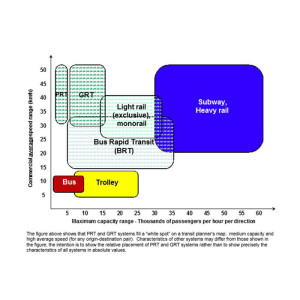
So, where do ATN systems fit on a transit planner’s map? Where medium-capacity, high-average-speed lines or networks are needed, in order to complement and improve a city’s existing transit network. Urbanization continues worldwide, and providing better urban mobility in the coming years will require multiple solutions, not just one. Driverless cars, or pods, will play an important role, especially when used as part of an Automated Transit Network with systematic ride sharing. Someday soon, the acronym PRT will no longer refer to “Personal Rapid Transit” but to “Pod Rapid Transit”. Regards to the naysayers!

atra-700

The figure to the right shows that PRT and GRT systems fill a “white spot” on a transit planner’s map: medium capacity and high average speed (for any origin-destination pair). Characteristics of other systems may differ from those shown in the figure; the intention is to show the relative placement of PRT and GRT systems rather than to show precisely the characteristics of all systems in absolute values.


About the author: Alexander Kyllmann is co-founder and CEO of ModuTram Mexico, member of the ATRA Industry Group.




WORKSHOP – Transit Vehicle Technology and Their Impact on Sustainable Transport TVT 2016

October 27th, 2015

Atra-Conf

23- 24 April, 2016 – Rome, Italy

In conjunction with the International Conference on Vehicle Technology and Intelligent Transport Systems – VEHITS 2016 


Chaired by:    Professor Rongfang (Rachel) Liu


The workshop will showcase various transit vehicle technologies and operations that have significant impact on the sustainable development of urban environment. The occasion will bring together researchers, practitioners, and decision makers from all over the world to explore the interaction between transportation, especially urban transit, and nature and built environment, energy consumption, and sociecty values.


ORGANIZER:

Telerik.Web.UI.WebResource.axd

Dr. Liu is a transportation professor in the Department of Civil and Environmental Engineering, New Jersey Institute of Technology (NJIT). Her research interests include Intermodal and Multimodal Transportation Planning and Engineering, Operation Research and Network Simulations, and transportation safety performance analyses. Rachel was the Chair for TRB Committee AP040: Automated Transit system (ATS) for 2008-2014. Dr. Liu has authored a number of books, book chapters, referred journal papers. She also made more than a hundred presentations in the transportation, urban planning, and related fields. She has just completed a book titled: Automated Transit: Planning, Operation and Applications, which will be published by Wiley and Sons.


TIME AND PLACE:

April 23-24, 2016. Rome, Italy.


SUBMIT PAPER/ABSTRACT:

http://www.vehits.org/TVT.aspx.

Room To Move

October 7th, 2015

ATRA-OCT7

Article by Will Ackel

If you’ve ever visited a water park, you’ve probably seen a “Lazy River” ride like Castaway Creek at Disney World’s Typhoon Lagoon or Rambling Bayou at Adventure Island in Tampa, Florida. They are shallow channels of water with a strong current. You can sit in an inner tube and just ride the current, or you can swim with the current, and get a boost that makes you feel like an Olympic swimmer. Some parks are completely encircled by a Lazy River that serves as a kind of transit system. The river is the guideway, and the stations are steps or ramps that lead into the water. In a Lazy River, traffic jams can actually be fun!

Automated Transit, in its simplest form, can also be configured as a single loop, with more complicated single-level networks comprising multiple intersecting loops. In the same way, a Lazy River could be expanded with additional loops. Of course the stretch of canal after a merge must have enough capacity to accommodate the combined water flow of the two canals that feed into it. Similarly, it must have enough flow to maintain the current in the two channels of the upcoming diverge. That means that the segment of canal between a merge and a diverge must have twice the cross-sectional area of the canals that feed into, or out of it. I refer to the part between a merger and a diverge as a double-density segment, and the parts leading into or out of it as single-density segments.

It is well known among automated transit engineers that single-level Automated Transit Networks (ATNs) also have single- and double-density segments. If two guideways that lead into a merge are each fully loaded with pods running at the minimum headway, the following segment of guideway cannot accommodate the traffic without violating the minimum headway requirement. This is why it is considered good ATN design practice to alternate merges and diverges. If there were two successive merges before a diverge, then you would have a triple-density segment.

This phenomenon is the source of the specious claim of automated transit critics that ATN systems cannot operate at more than half their capacity. They reason that in order for a transportation system to be economical, every part of it must be saturated with traffic at peak times. In the world of automobiles, this is known as gridlock. So by the flawed logic of the detractors, the only transportation system that is “practical” is one that is gridlocked.

It is true that a single loop can be packed with vehicles along its entire length. And that’s fine if all the places you want to go are arranged along that loop. But as soon as you add the opportunity to turn left or right, you are faced with the need for extra capacity. That’s because sometimes all the vehicles will want to go left, and at other times they will all want to go right. This is true for any kind of vehicle that does not follow a fixed route, including automobiles.

Think of one of those puzzles with the tiles that you are supposed to rearrange in numerical order by sliding them into the one open space. By the critic’s reasoning, that one empty space is wasted. But if you were to add one more tile, then nothing could move at all. How efficient is that? Mobility requires room to move. An adequate amount of unused capacity is not a design flaw – it’s a necessity.

Moreover, the only reasonable measure of a transportation system is customer satisfaction, which by definition includes everything that matters to people. No one chooses a mode of transport because it has better capacity utilization. What people care about are things like comfort, safety, reliability, simplicity, cost, and travel time (including any walking, waiting, parking, transferring, etc.). By that standard, automated transit runs circles around anything else.

Mr Ackel

Mr Ackel

A Very Brief History of Automation in Transportation

October 6th, 2015

ATRA-October

Article by : Wayne D. Cottrell, Ph.D. California State University, Long Beach.


Excitement, discussions, and progress continue with and around the rapidly developing technology of autonomous and self-driving cars. It is generally accepted that the notion of the automated car has been around since the 1920s, trials were conducted as early as the 1950s, and the first truly automated cars appeared during the 1980s. In the 30-odd years since the first automated cars were introduced, the idea has expanded greatly, to include experimental operation in mixed traffic, and the potential for mass production. In 2012, a Google driverless car successfully completed an urban trip chain, carrying a passenger who described himself as legally blind. Google’s cars had logged over one million miles on U.S. roads as of this writing. Technological improvements were still needed in inclement weather operation, obeyance of temporary traffic signals, complex intersections, object recognition, road surface imperfections, and safety officer signals. Experts within the Institute of Electrical and Electronics Engineers have forecasted that 75% of the world’s vehicles will be autonomous by 2040.

Atra 1 News Oct


A legally blind man prepares to take a spin in a Google self-driving car


While great strides and giant leaps are being made with driverless cars, a brief review of automation in transportation may be informative and useful. Automated processing in transportation is now commonplace, of course. Trip planning, ticket purchasing, travel reservations, seat selection, baggage payment, and other transportation components can all be managed using automated systems. Automation in propulsion and guidance, and the driverless transport of cargo and people, was demonstrated nearly a century ago in some modes, but is relatively novel in others. Elevators, for example, were manually positioned at stops (i.e., floors in buildings) until well into the 20th century. Although elevators have not been “piloted” since the days of hand-powered mechanisms, human intervention for precise door operations was needed until electromechanical circuits with relay logic were developed to better control positioning. These circuits first appeared in elevator systems in the 1930s. Today, most elevators are on-call and operator-free. Elevator operators are still seen in some department stores, subway stations, and amusement settings in Japan, the U.S., and elsewhere, however.

Automation in railroads – driverless trains – was first implemented in London in 1967, on the London Underground’s Victoria Line. The level of automation of the line is “Grade 2,” with automated operation between stations, but with an in-train driver who is responsible for controlling the doors at stops, detecting obstacles along the tracks, and emergency situations. Grade 4 automation, in which on-board personnel are for customer service only, was first implemented in an airport setting during the late 1960s (Tampa, Florida), in a university campus setting during the 1970s (Morgantown, West Virginia), in an urban downtown during the 1980s (Miami and Jacksonville, Florida; later Detroit, Michigan), and in a metro-subway system during the 1990s (Paris, France). Regarding the latter, European and Asian systems have taken the lead in using Grade 4 driverless trains in high-capacity operations. In the U.S., no Grade 4 high-capacity trains are in operation, although San Francisco’s BART system has had built-in Grade 4 capability since the 1970s. Further, some airport automated people-movers, such as Hartsfield International Airport’s (Atlanta) “Plane Train”, which carries over 60 million riders annually, are nearly high-capacity systems.

Atra 2


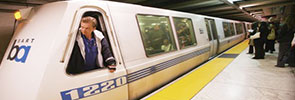
San Francisco’s BART trains have Grade 4 automation capability, but nonetheless have drivers


Predating elevators and trains, aviation may have been the first mode of transportation to implement automation widely. In 1929, James Doolittle, with his cockpit covered with a canvas to blind his vision, took off, flew and landed using instruments only. It was a 15-minute flight in the New York area, and into history. Further developments led to ground-based instrumentation, with the first fully automated landing of an aircraft occurring in 1964. Today, aviation regulations pertain to two types of operation: IFR (instrument flight rules) and VFR (visual flight rules). The VFR apply when an aircraft can be operated by visual cues only, such as during the daytime, under cloudless skies. The IFR apply otherwise, and for commercial aircraft, apply at all times, even if the plane can be operated safely under VFR.

Atra3


James Doolittle, under the canvas, and his copilot, get ready for the first “blind” flight (1929)


In this brief examination of automation in elevators, railroads, and aviation, there are plenty of lessons in development, policy and progress which may help guide the automation of other modes, such as motor vehicles.