Archive for September, 2017

History of the Advanced Transit Association (ATRA) Year by Year (7)

September 29th, 2017

atravid

History of the Advanced Transit Association (ATRA) Year by Year
by J. Edward Anderson, first ATRA President.
1982 – The Seventh Year.
Dr. Jerry Kieffer, as ATRA Board Chairman, wrote to the Board of Directors as follows:year 7


ATRA Co-Sponsored with the TRB New Systems Committee a Session at the January TRB conference. ATRA Board Member Catherine Burke chaired the session. She asked the speakers to address the following questions: (1) What are the advantages and who will benefit in the technology you present, (2) What are the technological, financial, or other barriers to implementation, and (3) Why do you believe this technology can succeed in being implemented?
James Lawson of Garrett discussed flywheel energy storage in electric buses. Clarence Adriance of Boeing discussed magnetically levitated system. Carl Walters of Lawrence Livermore discussed use of inductive power. George Paster, having left UMTA and joined UTDC, discussed the UTDC intermediate capacity transit systems planned for Vancouver and Toronto. The novelty in this steel-wheel, steel-rail system was that it used linear induction motors for propulsion. John Fruin of the Port Authority of New York discussed accelerating walkways. Bob Dietz of Gannett Fleming addressed problems of cost control in advanced systems. Mike Powells of BAA discussed how new technogies can be attracted to operating properties.
Under the new Reagan Administration, there was no work at UMTA on AGT, hence the Advanced Transit News reported on work on advanced transit-related concepts elsewhere.
Construction of the first line of VAL, the metro system in Lille, France was near completion. For aesthetic reasons, most of the line was underground. When completed, the system was to be able to transport 15,000 passengers per hour in two-car trains. The trains were automatically controlled and ran on 2 rubber tires. Lille was the first city in the world to be equipped exclusively with new-technology equipment.


7 year 6


AiResearch, a division of Garrett, was selected to manufacture a system of flywheel storage funded by UMTA.
A variety of advanced battery systems were subject to strong R&D, but delivery of functioning hardware was at that time nil. General Motors was testing a nickel-zinc battery and a zinc-bromine battery. The hope was to develop a battery with sufficient energy density to be used in buses.
Booz-Allen published a study on the use of hydraulic accumulator technology to regenerate braking energy in transit coaches.
Based on funding from UMTA, Transport Canada, and SNV of West Germany, a Dictionary of Public Transportation was published by N. D. Lea and SNV.
The Center for International Programs at Michigan State University sponsored a conference in London to offer American transportation managers an opportunity to study British modes of transport for people and goods.
The City of Helsinki, Finland, was nearing completion of the first section of its rapid rail transit system. The decision to build was made in 1969 and construction started in 1970. The construction and design of the system was done entirely by Finish firms. Each car has a capacity of 200 people. Train operation was automatic with an attendant present to operate if necessary. Part of the system was elevated and part underground. The total length is 11.2 km.


Helsinki Rapid Rail

Helsinki Rapid Rail


A 35-km rail line was being planned for Caracas. It would be steel wheel, steel rail, standard gauge, with 1500v DC third rail. They planned nine-car trains ultimately operating at 100 km/h and 4-minute headway. The trains could operate either manually or fully automatic.

The European Conference of Ministers of Transport published the results of a series of studies entitled “The Future of the Use of the Car.” Factors affecting car use were discussed and the relationship between private car use and public transportation were reviewed.
The text “Free Enterprise Urban Transportation” by Gabriel Roth and George Waynne discussed privately-operated, non-subsidized, and profitable public transportation modes operating around the world and analyzed their appliability to the U. S.
The NCTRP released two reports of its activities since its creation in November 1980: “Cleaning Equipment and Procedures for Cleaning Buses” and “Priority Treatment for Buses on Urban Streets.”

year7 3
On January 13, 1982, an accident occurred on the metrorail rapid transit system of the Washington Metropolitan Area Transit Authority. A six-car train derailed and collided with the center dividing wall between the main tracks while making an abnormal move at a crossover between stations. Three people were killed and 50 injured. An investigation showed that the cause was improper implementation of manual operating procedures.
In June 1982, the University of Minnesota Patent Office gave me a grant of $100,000 that allowed me, with two graduate students, to spend a year full time developing my new PRT system. By this time five patents had been applied for, two on the switch system, two on the guideway, and one on a novel control concept. Indiana Representative Dick Doyle provided $5000 to build the model shown here. The person on the left in the picture is Doyle and to the right me inspecting the model.

year 7 4

Spartan Superway Speeds Ahead

September 9th, 2017

bogle

an ATRA Pulse Article by BJ Furman 2017-09-08

Article below:

ATRA Pulse Article – Superway Speeds Ahead Fall 2017

The Driverless Taxi, Driverless Transit Nexus

September 9th, 2017

Driverless
Peter J. Muller, P.E.

Mercedes just announced they will start building driverless taxis in the 2020 – 2025 timeframe. These vehicles will cost far less than conventional taxis to operate and will likely provide an affordable means of transportation for many people who could then forego car ownership and save substantial money. Each driverless taxi will operate almost 24/7 and not that many will be needed before they dominate vehicle miles traveled (VMT). Some predict that they will be responsible for 90% of VMT by 2030.
This potentially rapid switch to driverless taxis could have profound positive and negative impacts. Mobility and safety will improve for many. However, taxi drivers, auto dealers, rental car companies, parking facilities, etc. will go out of business and/or have to reinvent themselves. In addition, contrary to common hype, driverless cars will add to congestion for many years before they reduce it (if they ever do).

Impact of Driverless Cars on Congestion Data source: ITS International

Impact of Driverless Cars on Congestion
Data source: ITS International

Some of the reasons for this are:
• Driverless taxis will add to VMT by driving empty to pick up the next fare
• Urban sprawl may increase with less expensive transportation
• HOV lanes that change direction for morning and evening peaks will no longer work
o This is because empty taxis returning for the next fare will balance flows in each direction
• Platooning, narrower lanes, etc. require most vehicles to be driverless and require infrastructure changes
Thus, the improved mobility will be hampered by increased congestion.
This is where driverless transit that has its own infrastructure fits in. Automated transit networks (ATN) are comprised of driverless small (car- sized) vehicles traveling on dedicated (usually elevated) guideways. Such systems have been in public service for decades and have higher capacity and average speed than light rail, while costing far less to build and operate. New generations of these systems are being developed that will provide quicker service than cars and have guideway capacity similar to seven freeway lanes.

ATN Station

ATN Station

ATN systems can be deployed along and/or adjacent to freeway corridors. A typical arrangement could consist of many interconnected one-way loops forming a ladder-like layout. The legs of the ladder could be about a mile or two apart and could straddle the freeway alignment. The rungs
would alternate in direction and provide access from one leg to the other. Offline stations could be located about half a mile apart on both legs and rungs. Thus, an area about two miles wide centered on the freeway would have a high-quality transit system within walking distance for most people. Many studies have shown that an ATN system will attract drivers from their cars and the freeway congestion would immediately start to diminish.

Schematic ATN Layout

Schematic ATN Layout

But what about the people further away from the freeway? This is where driverless taxis could play a key role. These areas are likely to be less congested and the taxis and autonomous shuttles could very effectively bring people to the ATN stations thereby greatly increasing the transit service area and the ridership. Furthermore, an ATN system creates jobs for the initial construction as well as for operations and maintenance.

Transit mode share with and without ATN Source: Studies in named cities

Transit mode share with and without ATN
Source: Studies in named cities

The combination of driverless taxis and transit could be the best way to deal with the coming driverless revolution.
Peter Muller is President of both PRT Consulting Inc. and the Advanced Transit Association. He can be reached at pmuller@prtconsulting.com

History of the Advanced Transit Association (ATRA) Year by Year (6)

September 8th, 2017

atravid

History of the Advanced Transit Association (ATRA) Year by Year
by J. Edward Anderson, first ATRA President.

1981 – The Sixth Year.

This spring ATRA elected a new slate of officers. Dr. A. M. (Tony) Yen, president of Technology Research and Analysis Corp. of Arlington, VA, was elected President of ATRA. Dr. Catherine Burke, Associate Professor of Public Administration at the University of Southern California was elected Vice President; and Dr. Duncan MacKinnon, Chief of the UMTA Advanced Development Program, was elected Treasurer. At its July 11 meeting, the Board of Directors elected Dr. Jerry Kieffer Chairman.

Dr Tony Yen

Dr Tony Yen

Barriers to Technology Development were discussed at an ATRA session at the Transportation Research Board (TRB) annual meeting on January 14, 1981. Al Sobey of General Motors and formerly of TTI/Otis said that federal R&D by itself inhibits private development. When the federal government preempts private industry by doing the same work and making it available to everybody else, it discourages private initiatives. Moreover, experience has shown that UMTA is reluctant to accept new ideas from the outside; and has mandated designs that freeze technical concepts, inhibit the feedback from field experience, diffuse responsibility for designs, and discourage innovation. Dick Hacker of Boeing stated that the two primary barriers to technology deployment are 1) the lack of common understanding of the need or scope of transit technology that users, operators, industry or the nation will support, and 2) the lack of a long-term national commitment to urban transit technology that transcends short term political and funding cycles.

UMTA’s Automatic Vehicle Monitoring (AVM) Program was aimed at improving schedule unreliability in large transit systems and on heavily traveled routes where buses often bunch together, creating long headways after the consecutive arrival of several buses at each stop. In an AVM system, elecronic and computer technology was used to automatically monitor the location and progress of the vehicles in a fleet.

While the newly elected Reagan administration announced that federal funding for DPM projects would be eliminated, funding for the Miami and Detroit DPM projects were sufficient for those projects to proceed. Money in the UMTA budget for innivative techniques and technology introduction was completely eliminated. Funding for AGRT was reduced to $8.6 million. UMTA intended to discoutinue the AGRT development program, but it managed to continue until 1986, and produced valuable information about control that was useful for PRT.

UMTA

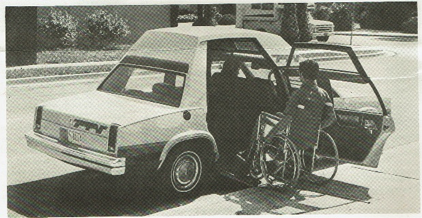
UMTA’s Paratransit Vehicle Program continued. Its goal was to stimulate the auto-motive industry to manufacture vehicles that would meet the needs of paratransit service at an affordable cost. As shown here, these vehicles would be equipped with a wheelchair access ramp that is deployed by the driver. It was felt that a shift in policy at the Federal level could help spur the widespread introduction of innovative transit technologies for the elderly and handicapped. The new policy could lead many transit cities to opt for providing door-to-door specialized services such as shown here in an UMTA-funded program.

The ATRA Board held a discussion of the following topics related to the current decline of federal funding for public transit:  1) Can new technologies still play a role?  2) Financial incentitives via deregulation.  3) Free marketplace economics for public transit, and  4) Can low- income citizens still be served by public transportation?

In his opening message, ATRA President Tony Yen said: “We can fill an important gap left by the decline of federal guidance for transit R&D. Doing this has the advantage that it will help ATRA identify new institutional frameworks through which support for R&D in technology can be obtained.”

The Regional Plan Association studied household auto use in New York State to help policy makers anticipate auto use under different curcumstances. A principal finding was that neighborhood population density has a greater effect on the number of miles a household drives than a variety of other variables such as the number, age, or fuel economy of cars owned.

Thanks to a grant of $300,000 from the US DOT, the City of Las Vegas initiated a study of the feasibility of a high-speed (300 mph) passenger train connection to Los Angeles. This was the first study of this type to receive a federal grant.

ATRA planned a session on New Transit Technologies and Issues to be held at the January 1982 TRB Meeting in Washington, D. C. The technologies to be considered were: 1) Composite Flywheel Energy Storage and Propulson for Bus Applications, 2) Magnetically Levitated Urban Transit, 3) New Transit Systems in Canada, 4) An Acelerating Walkway Application, 5) Future Trends in Technology Deployment, and 6) Methods for Cost Control in Implimentation of Advanced Systems.
In May 1981 a two-year study of automated transit systems for the downtwon area of the City of Indianapolis was completed. The study found that an automated transit system could be feasible in Indianapolis subject to preliminary engineering studies. Consultants to the city included Barton-Aschman Associates, Inc. as prime contractor with Anderson/MacDonald, Inc. as one of the subcontractors. A range of elevated AGT systems with vehicles accommodating 60, 40, 20, 12, and 3-passengers were considered.


The 3-passenger vehicle network for Indianapolis

The 3-passenger vehicle network for Indianapolis

The result of the Indianapolis study was that the smaller the vehicle the lower was the total cost per passenger-mile, due both to improved service and decreased guideway cost. For reasons of personal security, the League of Woman Voters in particular rejected the larger vehicles in favor of the 3-passenger vehicle in which one would ride only with chosen passengers or alone. They imagined rides in off-peak periods shared with unknown persons and said “No thanks”. At the time, the only 3-passenger vehicle available was the German Cabintaxi. Since that program was terminated in December 1980, attemps were made to find an American company willing to take it over, but no such company was found.

On November 16, 1981 Jerry Kieffer, as ATRA Chairman, wrote to the ATRA Board Members with concerns of that time. In part, he said “Transportation policy makers have an urgent need to have more options for providing effective service and for developing capital and operating resources. ATRA can play a helpful role in stimulating fresh thinking and in widening the circle of awareness about such thinking. That was what ATRA was first set up to do, and clealy we should be greatly challenged by what needs doing now. In the weeks ahead, we will be asking the ATRA Board to advise on particular themes or ideas that could be adopted for association development and consideration, along with possible formats for presentation of such themes, or specific ideas within themes.”

For several years since 1976 I had been the U. S. Representative for Cabintaxi. Because of termination of that program, my colleague Ray MacDonald and I began thinking of a new design. Since I was to teach Senior Mechanical Engineering Design during the three quarters of the academic year 1981-82, I assigned to groups of about 15 senior mechanical engineering students each quarter successive aspects of the design of a new PRT system. This enabled me to spend at least half my time working on an improved PRT system. As indicated in the chapter on structures in my book Transit Systems Theory, I had found that the minimum-cost guideway was narrower than the vehicle. The Aerospace Corporation1 had reached the same conclusion and had placed a vertical chassis inside a U-shaped guideway. Cabintaxi had also reached the same conclusion about need for a narrow chassis, but placed chassis components outside a narrow vertically oriented box-beam guideway, which made the merge and diverge sections of the guideway complex and expensive. Thus, for my design classes, I specified a guideway design similar to that propose by The Aerospace Corporation, but to minimize cost my guideway would be a truss structure. The first version of my guideway is illustrated here.
CabinTaxi1

For reliable, all-weather, maximum throughput in vehicles per hour, both Aerospace and DEMAG+MBB (developers of Cabintaxi) used linear electric motors with system designs initiated in the early 1970s. A serious problem then was solved in the late 1970s by the variable frequency drive, which if used properly markedly increased the efficiency of a linear induction motor. Hence, with the advice and assistance of two Electrical Engineering Professors, I specified the LIM and VFD.

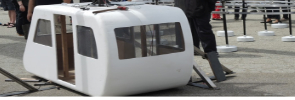
My first vehicle design

My first vehicle design


[1] Available on www.advancedtransit.org/Library/Books.